

You report an injury at work, expecting your employer to help you begin the workers' compensation process.
Instead, you hear:
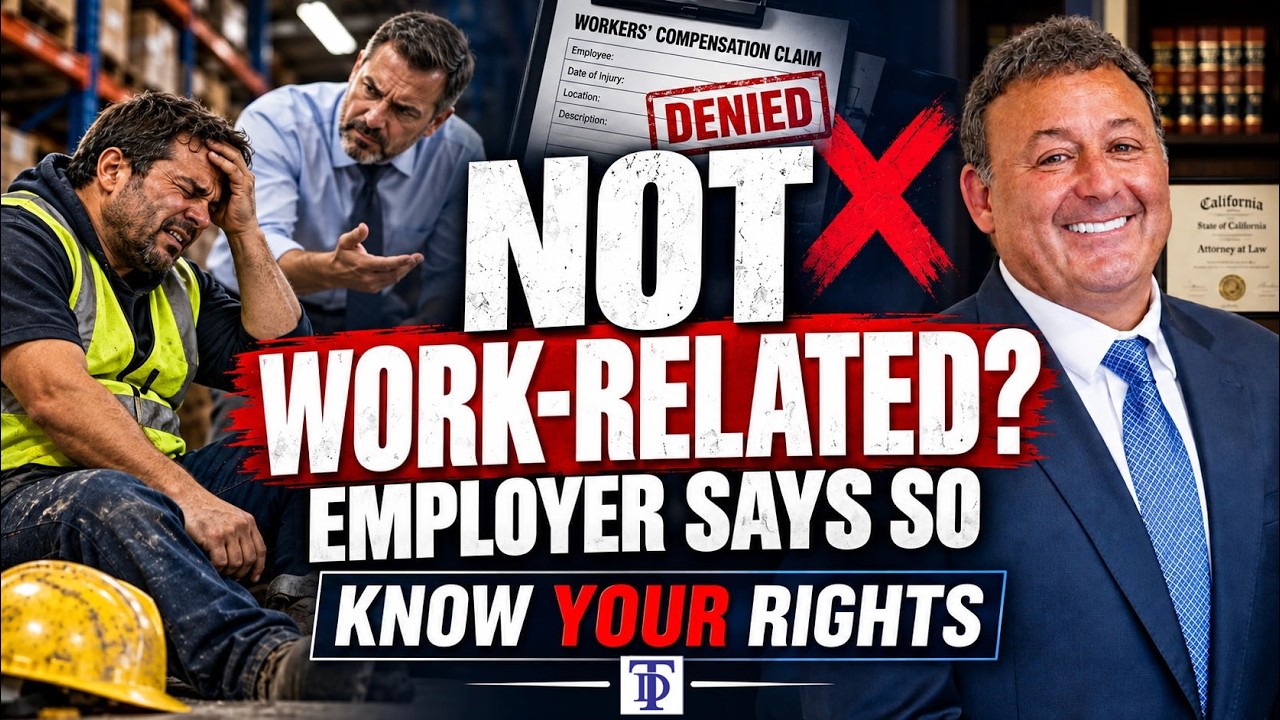
What your employer says"We don't believe your injury happened here."
Maybe your employer says you hurt yourself at home. Maybe they blame an old injury, a weekend activity, or a medical condition you already had.
Hearing that can make you wonder whether your workers' compensation claim is over before it even begins.
It isn't.
Your employer can dispute what happened, and the workers' compensation insurance company can investigate your claim. But your employer's opinion by itself does not decide whether your injury is legally work-related.
I'm Thomas DeBenedetto. I've represented injured workers in California since 1992. During more than 34 years of workers' compensation practice, I've represented thousands of injured workers and recovered more than $1 billion in benefits.
One of the questions I hear frequently is what happens when an employer looks an injured worker in the eye and says:
What your employer says"We don't believe you. We believe you were injured somewhere else."
The important thing to understand is this:
Who Decides Whether My Injury Is Work-Related?
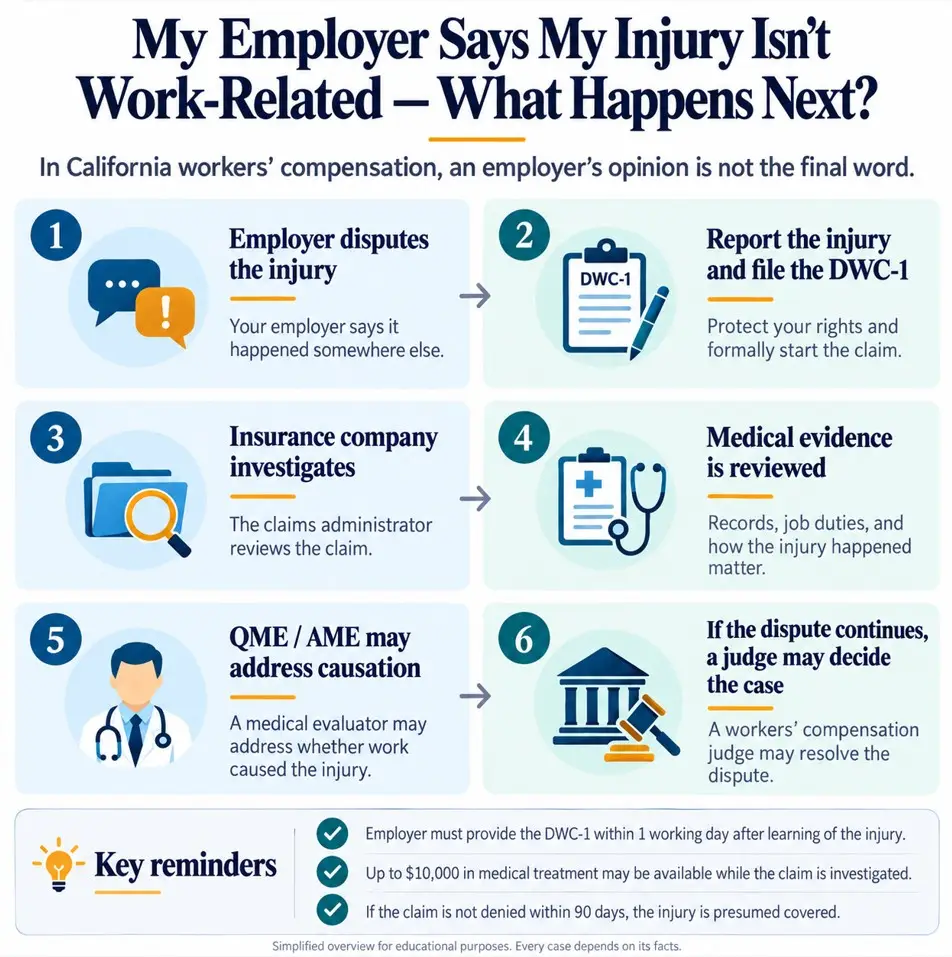
California workers' compensation law looks at whether an injury arose out of and occurred in the course of employment. You may hear attorneys, doctors and insurance companies refer to this as AOE/COE.
Put simply, the question is whether your work caused or contributed to your injury.
When that becomes disputed, the answer is not based simply on whether your supervisor believes you.
Medical records, how the injury occurred, your job duties, when the injury was reported and other evidence can all become important.
In some disputed cases, a Qualified Medical Evaluator, commonly called a QME, may evaluate whether an injury or illness was caused by work. If you have an attorney, the attorneys and claims administrator may sometimes use an Agreed Medical Evaluator, or AME, instead.
If the dispute cannot be resolved, it may ultimately be brought before a workers' compensation judge.
That is very different from your employer simply saying:
What your employer says"I don't think you got hurt here."
If your employer disputes whether your injury happened at work, the process can feel confusing. This overview shows how a disputed work injury may move through the California workers' compensation system.
Can My Employer Deny My Workers' Compensation Claim?
There is an important distinction here.
Your employer can dispute your version of what happened. The workers' compensation claims administrator can also investigate your claim and issue a formal denial.
But neither means you automatically lose your case.
A denial is the insurance company's position on the claim. California's workers' compensation system provides a process for challenging disputed claims, developing medical evidence and bringing unresolved disputes before a workers' compensation judge.
So if your supervisor tells you that your injury did not happen at work, do not assume the matter has already been decided.
And even if you later receive a denial letter from the insurance company, that does not necessarily mean your case is over.
Why Medical Evidence Matters
When an insurance company questions whether your injury came from your job, medical evidence can become one of the most important parts of the case.
Your doctor may need to understand:
- What you were doing when the injury occurred
- The physical demands of your job
- When your symptoms began
- Whether you had similar symptoms before
- Whether your work aggravated an existing condition
- How your condition has changed since the injury
This is why telling your doctor exactly what happened matters.
Do not exaggerate what occurred.
But don't minimize it either.
If lifting, pushing, pulling, repetitive motion, a fall, an accident or another part of your work contributed to the injury, your medical providers need accurate information about it.
Medical disputes over whether an injury was caused by work are one of the issues California's QME process is designed to address.
What Should I Do If My Employer Says I Was Injured Somewhere Else?
The first thing I would tell an injured worker is:
Here are several practical steps that can become important.
Report the injury
Tell your employer or supervisor about the injury as soon as possible.
If you already reported it verbally and your employer is disputing what happened, putting the important details in writing can help create a record of when and how you reported the injury.
California DWC advises injured workers to report an injury promptly. If an injury or illness developed gradually, you should report it when you learn or believe it was caused by your job.
Request and complete the DWC-1 claim form
Your employer must give or mail you a workers' compensation claim form within one working day after learning about your injury or illness.
Complete the employee portion, sign and date it, return it to your employer and keep a copy.
If your employer refuses to give you the form, you can obtain one directly from the California Division of Workers' Compensation.
Write down what happened
While the events are still fresh in your mind, write down:
- The date and approximate time
- Where you were
- What job task you were performing
- How the injury happened
- When you first noticed symptoms
- Who you told
- Anyone who saw the incident or saw you shortly afterward
Small details can become harder to remember months later.
Preserve evidence
Depending on the circumstances, useful evidence might include:
- Text messages
- Emails
- Photographs
- Incident reports
- Work schedules
- Names of coworkers
- Security-camera information
- Communications from your employer
- Letters from the insurance company
You don't need to turn yourself into an investigator.
You simply don't want important information to disappear.
Keep the insurance company's letters
If the claims administrator delays or denies the claim, keep every letter you receive.
The letter may tell you why the company is questioning the claim and what information it believes is missing.
That can be very important when an attorney reviews your case.
What If Nobody Saw Me Get Hurt?
This comes up often.
A worker may be alone when lifting something, climbing a ladder, moving equipment or performing another job task.
The fact that nobody actually saw the injury happen does not automatically mean the injury wasn't work-related.
A workers' compensation case is not decided solely by whether someone happened to be standing next to you at that exact moment.
Other evidence may help establish what occurred, including your medical records, when you reported the injury, what you told your employer, your job duties and the consistency of the evidence surrounding the claim.
Witnesses can certainly be helpful.
But the absence of an eyewitness does not automatically end a workers' compensation case.
What If I Had an Old Injury or Pre-Existing Condition?
Another common response from an employer or insurance company is:
What the insurance company says"You already had that problem."
For example, you may have had previous back pain, arthritis, a prior knee injury or degenerative changes that show up on an MRI.
That does not automatically answer whether your current condition is work-related.
A prior condition and a new work injury can exist at the same time.
Work may also aggravate or accelerate an existing medical problem.
The important question becomes what caused your current condition and what role your employment played.
Those are medical issues that may require careful evaluation.
So if an employer says:
What your employer says"Your back was already bad."
don't assume that statement ends the discussion.
What Happens After I File the DWC-1?
Once you file the workers' compensation claim form, the claims administrator begins handling the claim.
California DWC states that the insurance company generally has 14 days to send you a letter telling you the status of the claim.
There are also two protections that injured workers should know about.
First, within one day after a claim form is filed, the employer must authorize appropriate medical treatment. While the claim is being investigated, an injured worker may receive up to $10,000 in medical treatment.
Second, if the employer does not deny the claim within 90 days after the completed claim form is filed, the injury is generally presumed to be covered.
That is another reason not to allow an employer's verbal statement to prevent you from formally starting the claim process.
What Happens If the Insurance Company Denies My Claim?
A denial can feel final.
It isn't necessarily final.
California DWC specifically explains that if you want to object to a denied claim, you can file a case with the Division of Workers' Compensation. Its district offices function as trial courts where disputes arising from workers' compensation claims are decided by a judge without a jury.
Medical evidence may become central to that dispute.
A QME may be asked to address whether your injury was caused by your work. If you have an attorney, an AME may sometimes be used instead.
Your attorney can help develop the medical and factual evidence, respond to the insurance company's position and, if necessary, present the dispute before a workers' compensation judge.
This is why I tell injured workers not to view a denial letter as the insurance company having the last word.
It means there is a dispute.
And disputes can be challenged.
Your Employer's Opinion Is Not the Final Word
When you're injured, hearing your employer say:
What your employer says"We don't believe you."
can be upsetting.
It can also cause you to question yourself.
Maybe you start wondering whether you should even file a claim. Maybe you're concerned about your job. Maybe you assume the insurance company is going to believe your employer rather than you.
Don't confuse your employer's position with the final outcome of your workers' compensation case.
Your employer may dispute the injury.
The insurance company may investigate it.
The claims administrator may even deny it.
But California has a process for resolving those disputes, and medical evidence can play an important role in determining whether an injury is work-related.
As I explain in the video above, an attorney can help obtain the evidence needed to support the claim and, when necessary, take that dispute before a workers' compensation judge.
Frequently Asked Questions
Can my employer decide that my injury isn't work-related?
Your employer can dispute how the injury happened, but your employer's opinion alone does not determine whether the injury is compensable under California workers' compensation law. The claims administrator may investigate or deny the claim, and unresolved disputes can be decided through the workers' compensation adjudication process.
My boss says I was hurt at home. What should I do?
Report the injury, request and complete the DWC-1 claim form, document what happened and keep relevant medical and workplace records. If the claim is disputed or denied, a California workers' compensation attorney can review why the employer or insurance company is challenging it.
What if nobody witnessed my injury?
A lack of eyewitnesses does not automatically prevent you from having a workers' compensation claim. Medical records, your account of what happened, when you reported the injury, your job duties and other evidence may all be relevant.
What is a QME?
A Qualified Medical Evaluator, or QME, is a physician certified by the California Division of Workers' Compensation to conduct medical-legal evaluations. A QME may address disputed medical issues, including whether an injury or illness was caused by work.
Does a denial mean my workers' compensation case is over?
No. California provides a process for challenging a denied workers' compensation claim. Depending on the circumstances, medical evidence may be developed and the dispute may ultimately be heard by a workers' compensation judge.
Your employer may dispute the injury. The insurance company may investigate or deny the claim. But that does not necessarily end your case. Know your rights and understand the evidence that may matter.
Talk with Thomas DeBenedetto About a Disputed Work Injury
If your employer or its insurance company is telling you that your injury did not happen at work, don't assume you have to accept that conclusion.
I've represented injured workers in California since 1992. During more than 34 years of workers' compensation practice, I've handled hundreds of trials and helped recover more than $1 billion in benefits for injured workers.
If your injury is being questioned, my team and I can review what happened, look at the evidence and explain what options may be available to you.
No cost. No obligation. Just answers.
This article is provided for general educational information and is not legal advice. Every workers' compensation claim depends on its individual facts and circumstances.
